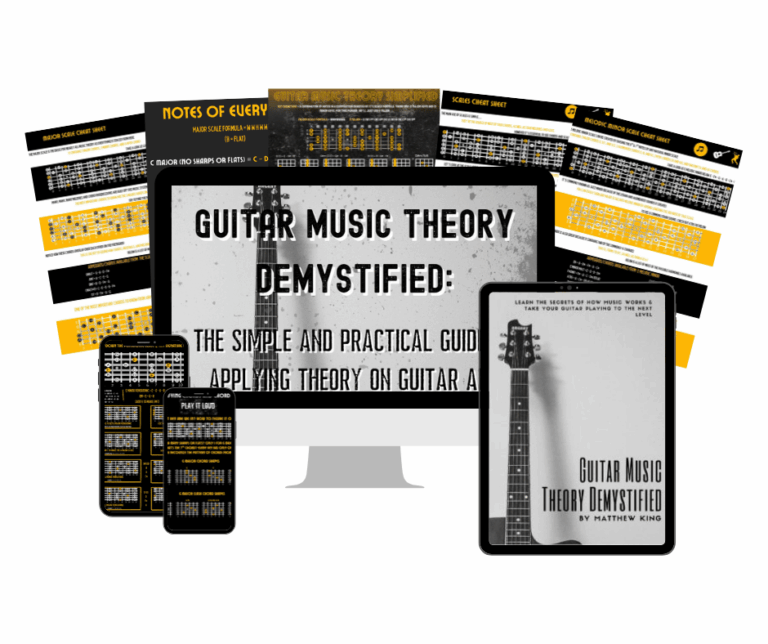
Musical Key Signature: A collection of chords, scale tones, and chord progressions that can be traced back to a specific set of notes. Major keys and minor keys are made from a formula of whole steps and half steps, which make the series of 7 notes that define every musical key.
Half Step and Whole Step: This refers to moving up or down a fret, which is measured in half steps. Fret 1 to fret 2 on the low E string, or any string, is a half step, while fret 1 to fret 3 is a whole step, which is equal to 2 half steps.
Scale: any set of notes played in a series. Major scales use the major scale formula while minor scales use the minor scale formulas. In guitar music theory, lots of scales are taught in patterns for the ease of teaching and learning them.
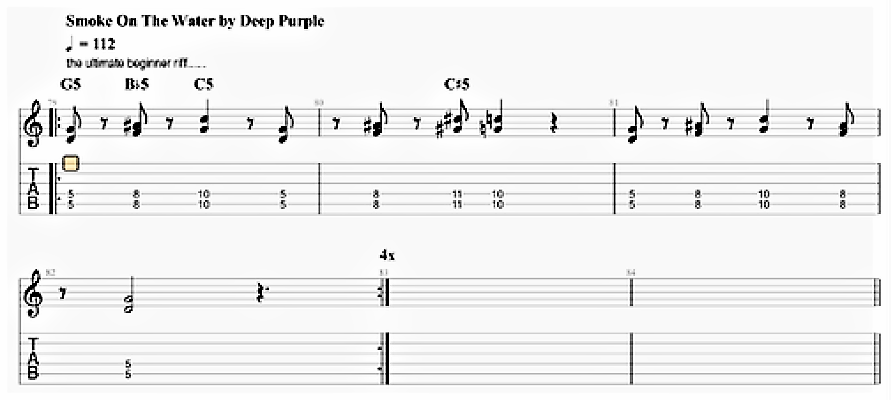
Chord: Any set of notes meant to be played at once and not in a series. An “arpeggio” is a chord broken up into single notes. Chords can be full 6 string chords like your basic open chords, triads where the 3 basic chord tones are played, or as “dyads” like the famous powerchord.
Interval: This is the distance between any two notes. When you’re playing a “dyad” like a powerchord you’re often playing an interval together, like E5 being a perfect fifth from E to B. There are many intervals out there, which in an incomplete list boils down to: major and minor 2nds, unisons, major and minor 3rds, perfect 4ths, perfect 5ths, diminished 5ths, major and minor 6ths, suspended intervals, major and minor 7ths, diminished 7ths, octaves, and “extended” intervals like 9s, 11s, and 13s.
Mode: This is a scale created by starting a note on a scale other than the “root” of a scale, like playing a C major scale starting on the 2nd note of the scale, D. The modes many people think of are the modes of the major scale which are Dorian, Phrygian, Lydian, Mixolydian, Aeolian, and Locrian. Harmonic minor and melodic minor scales have their own modes too. Since you’ve been reading this far, a key element to understanding intervals is to understand that D Dorian doesn’t have the same chord possibilities as D minor or D major. This is because these scales each have a slightly different set of notes that comprise them.
Harmony and Roman Numerals: Harmony is the study of mixing intervals together to create chord progressions and musical textures basically. A lot of contemporary pop music uses “diatonic” harmony, where you only use chords that can be made from the notes of a major or minor scale. “Chromatic” or “outside” harmony uses chords made from notes that are not a part of the major or minor scale/key the song is based in, and it’s very common. We use roman numerals to designate which chords in a musical key we’re playing, like the I being the first chord, the IV being the fourth chord, and V being the 5th chord.
7 Chords: I included this because I struggled for awhile to understand where these chords came from. Every chord in a musical key can be “extended” by adding it’s relative 7th interval. This is a wider topic to explain, but every diatonic musical key will have two maj7 chords, 3 m7 chords, 1 m7b5, and 1 dominant 7 chord.
CAGED: This is an acronym describing a sequence of chord shapes that occurs naturally on the fretboard. The C shape, A shape, G shape, E shape, and D shape will all appear across the fretboard in that order. Many teachers online claim it’s a big secret to unravel when the actual secrets are the knowledge of how chords, keys, and harmony works. When you know that, the CAGED system seems too simple to capture all that the fretboard is capable of doing.
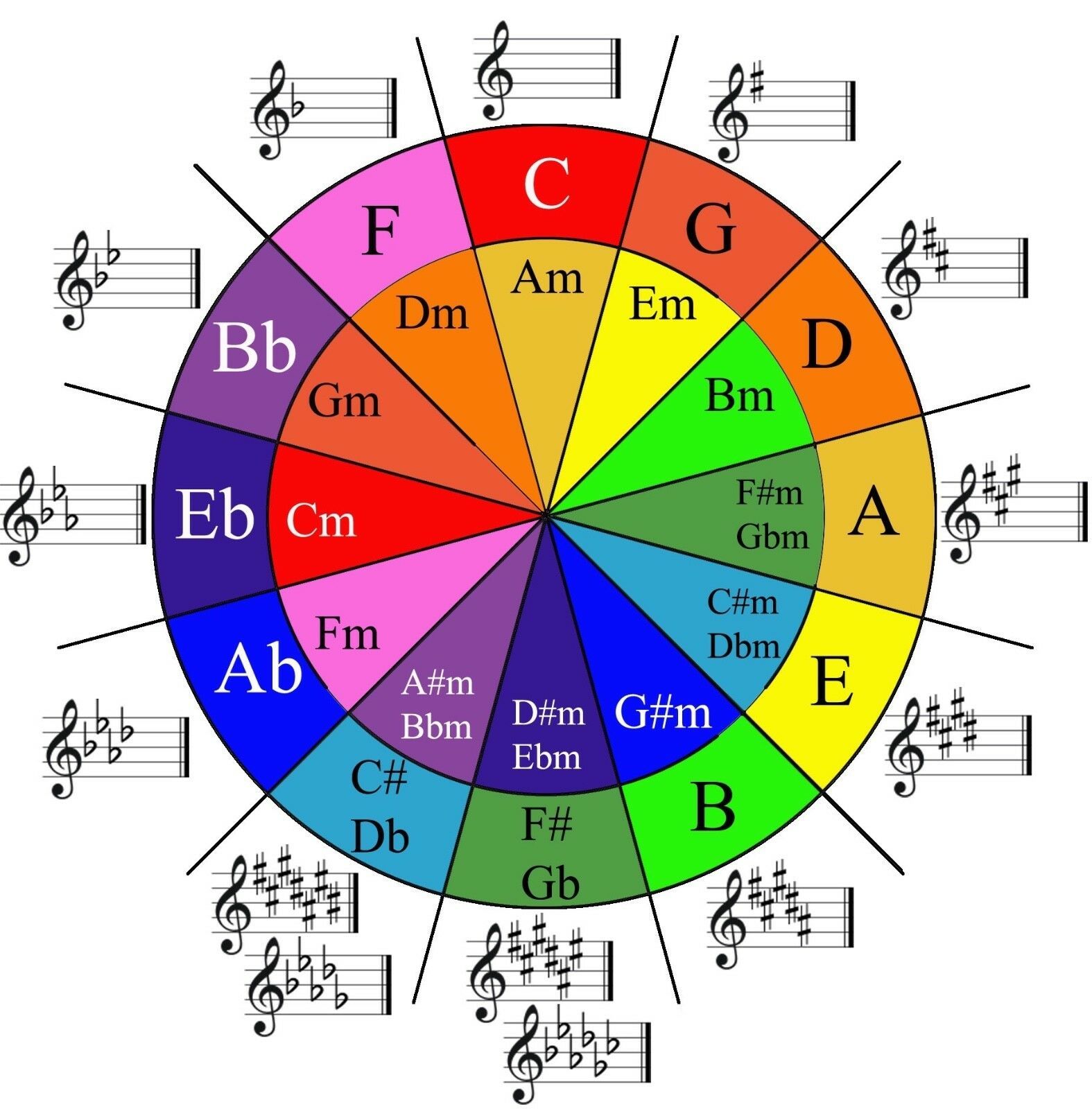
Circle of Fifths: This is a musical theory concept to help organize all the musical keys into a series of perfect 5th jumps up or down. For instance, C goes to G, a perfect 5th up. G then goes to D, another perfect 5th up, and D to A to E to B and so on. If you go from C to F, down a perfect 5th, the same relationship occurs. This is more of a gimmick in my opinion as the knowledge of keys being a 5th up or down is useless without a core understanding of how key signatures are made. It’s also a lot easier to just remember the number of sharps or flats in a key.
The Advanced Music Theory Skills
I think this is important to mention because I believe this is what people think of when they gloat that “they don’t know or use theory!”
I’ve studied their music and it’s obvious they use intervals, scales, rhythms, and chords to make riffs and melodies.
Here’s what they probably can’t put into words:
Voice leading & harmonizing: this is the study of how to put chords and intervals together basically, but it’s much more in-depth than that. I promise you that nearly every chord you’ve ever heard or imagined has been categorized into some kind of harmonic device. Voice leading is where you choose a chord/harmony to go with the top voice of a composition, which is usually the melody. Chord melody pieces for guitar are just exercises in voice leading.
Counterpoint: this is the art of arranging the various voices of a chord or arrangement so that they sound independent from one another. Bach was the ultimate master of this type of musical composition though there’s been plenty of masters ever since. Basically, you would learn to write parts that move in parallel motion, contrary motion, and/or oblique motion and to know when and where to use them. This is also called “contrapuntal” writing as the various notes are all going in different directions.
Orchestration: this is where you choose which instrument plays which part and where in a musical arrangement. This is a separate humongous study from harmony, which is its own world. As you are probably aware, many orchestras are huge, and it can be overwhelming to learn which ones are appropriate for which pitch ranges, as well as what instruments and instrument groups work best together. Thankfully in contemporary music and rock/metal music, we only have to worry about writing for vocals, guitars, drums, and bass. Nowadays synths, drum machines, samples, loops, and special effects also comprise many arrangements and can be considered an additional part of the tools of instrumentation/orchestration.
Chromatic harmony: this is a particular favorite of mine. It’s not just dark chord sounds like diminished chords or outside chords, but generally anything where you’re not restraining yourself to the choices of a diatonic musical key. Jazz for instance makes use of frequent key changes/modulations using bright pretty sounding chords like maj7s and 9s and 13s.